
When the Emergency Hits, It's Too Late to Plan
Pilots never build their emergency procedures mid-flight — and your business shouldn't build its recovery plan mid-crisis. The difference between a disruption and a disaster is almost always preparation.
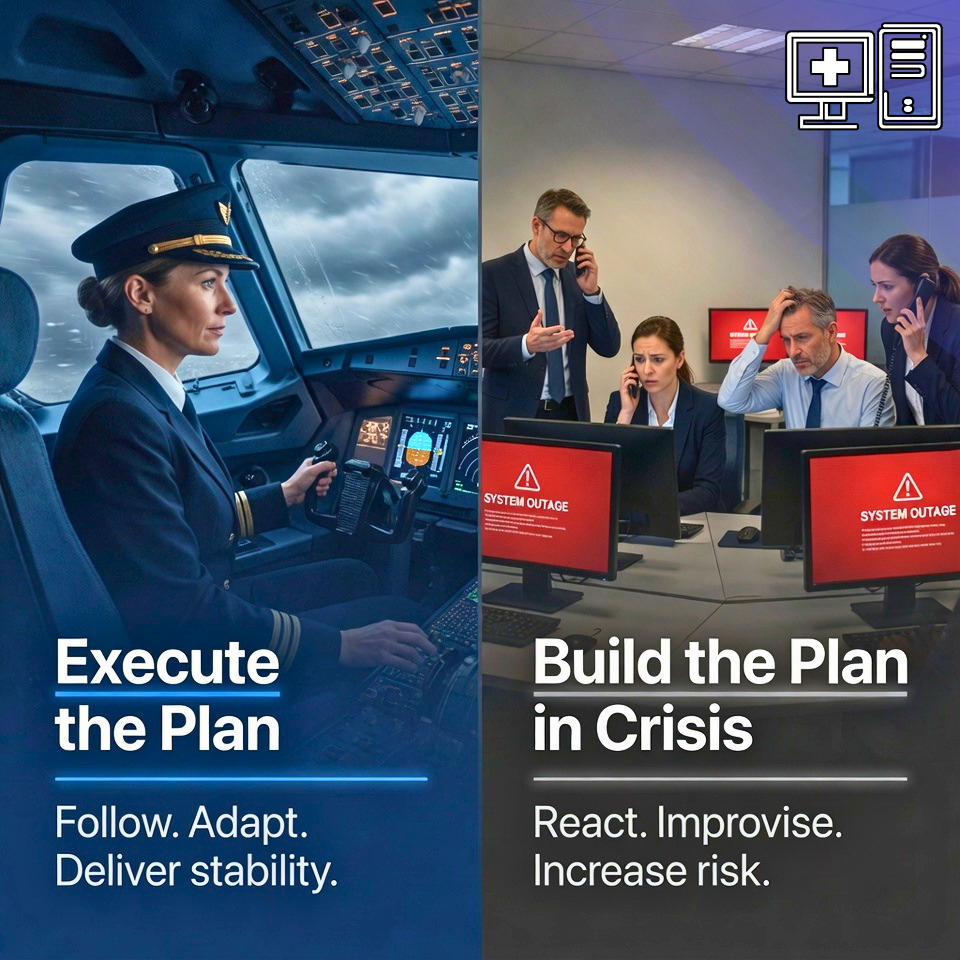
When your flight hits turbulence, the last thing you want to hear from the pilot is, "Give me a minute — I've never handled this before."
Flying feels safe not because problems never happen, but because pilots spend thousands of hours preparing for situations they hope they'll never face. When something goes wrong, their response is already built. All they have to do is execute it.
The same principle holds across every profession where mistakes are costly — medicine, emergency response, manufacturing. The emergency is the time to execute the plan, not build it. Many businesses haven't made that distinction yet.
Most owners invest in backups, security tools, and software to reduce risk — but preparation often stops at setup instead of extending into how the team actually responds in the moment. That gap stays invisible until something breaks.
The Emergencies Nobody Practices For
Disruptions rarely wait for a convenient moment. They show up during normal operations and force immediate decisions under pressure, affecting multiple parts of the business at once. Systems fail, files disappear, internet outages interrupt workflows, cyber incidents block access, and critical applications become unavailable without warning.
Most business owners understand these scenarios well enough to prepare for them. But when something actually breaks, questions that should be easy to answer suddenly become complicated:
- Who takes charge?
- What gets restored first?
- How long will this take?
- What do we tell customers?
Teams often work through those answers during the disruption itself — which slows decisions, delays execution, and adds confusion where there should be clarity.
The Hidden Cost of Learning Mid-Crisis
When a business is figuring things out during a disruption, the impact spreads quickly, because every step requires a decision that was never made in advance. Leaders pause to evaluate options instead of acting. Teams wait for direction before moving forward. Progress slows as each action depends on the last one.
That delay ripples across the whole organization. Employees lose time waiting for access or guidance, work stalls across departments, and momentum drops as teams try to regain control. Customers feel it next: response times increase, communication becomes inconsistent, and confidence erodes when the business can't operate at its usual pace. Recovery takes even longer, because teams are forced to prioritize while they restore — which stretches downtime and deepens the disruption.
Picture two companies facing the exact same outage. Same systems down. Same scope of disruption. Same starting point. One has practiced for this: ownership is clear, priorities were decided in advance, and the team moves through defined steps while keeping customers informed throughout. The other is building its response as it goes — every decision triggers three more questions, hours pass, and what could have been a minor disruption becomes something closer to a disaster.
The bottom line: The difference between a disruption and a disaster is almost always preparation.
The Value of Being Ready
No passenger expects the pilot to improvise procedure during turbulence. No patient expects the surgeon to figure things out mid-operation. The expectation across every high-stakes profession is the same — preparation happens before anything goes wrong, so when something does, the response is already there.
Businesses that operate this way respond faster, assign ownership clearly, and move through recovery without hesitation. Teams don't stop to figure out the next step; they simply take it. Customers experience less disruption, because the business doesn't have to stop operating in order to figure out how to keep operating.
Preparation feels unnecessary — right up until the moment it becomes critical.
We've seen what happens when businesses are ready, and when they aren't. We've worked with small businesses through system failures, ransomware incidents, and outages that could have caused serious damage. The ones that came through with their operations and reputations intact weren't necessarily the ones with the most sophisticated technology. They were the ones who had a plan — and a partner who knew how to execute it.
That's what we do. We fix things when they break, and we help make sure you're never starting from scratch when it matters most.